First Timer’s Guide to Agile Mobile Development: Exploring the different phases of mobile app development
Learn moreSwipe to Check More
By Monica Chauhan, Which Company is Best for App Development? — Corewave Tech Pvt Ltd, Sector 63, Noida, India
Quick Answer
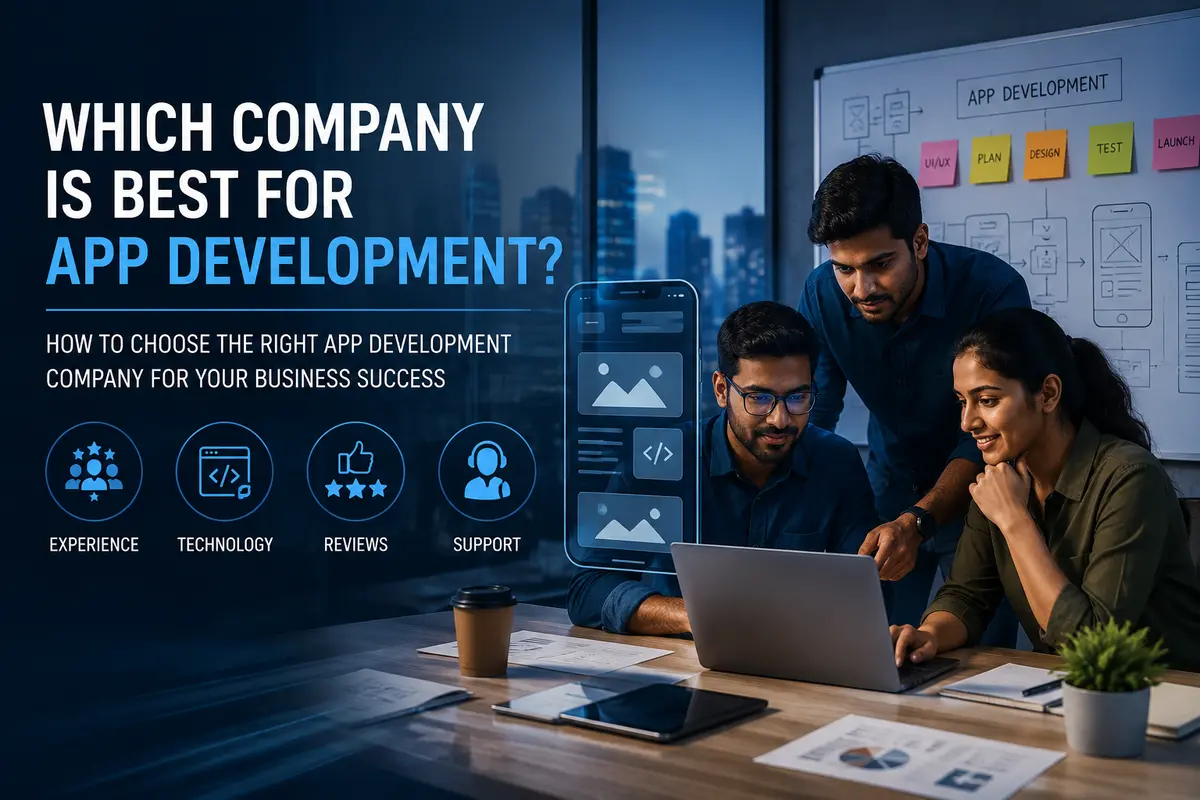
The best app development Company isnt one and the same for everyone. Your budget, industry, and how much you can verify determine the right fit. Assess the potential partnerships based on three criteria: a project history you can confirm with client references, the ability to engage the engineers who can work on your app, and a written support commitment post app launch. A company that clears those three criteria is a better option than one that claims to be the best on their website.
When you search for answers online, you will notice many Top 10 and Top 15 ranking posts. Move past the Top 3 or Top 5, and you will notice that every list ranks the company that published the list first. That’s no fluke and not helpful to you, the client.
The truth is that the term "best" isnt exclusive to any of the companies. Rather, it is the match that a firm can demonstrate for the needs of a client. A payments app developing company in the Fintech space may be a great fit for a payments app, while it may not be a good fit for a logistics firm that requires an app for tracking and integrating its fleets, even if both the firms claim to be "leading" on their respective websites.
Getting this wrong does have consequences. KPMG reported that 70% of organizations experienced at least one failed project in the last year. Standish Groups CHAOS research, which is considered the most important research on software on outcomes, has found that approximately 19% of software endeavors end up being complete failures, with a larger, overbudget, and/or overtime majority. The difference between a project that succeeds and a project that fails is often this kind of vetting, which is the reason Corewave Tech begins its process with direct developer access and line-item quotes rather than just a single number. This article suggests that you ask for both.
Instead of providing yet another ranking, here are things that distinguish an honest, reliable app development partner from those that claim to be honest and reliable.
It is simple to make a screenshot page on your web page. Make a list of several references in your industry and call them. Ask the reference what went wrong in the project, rather than what went right. Every real world project has friction, and the way a company manages that friction is more important than the end screenshots.
When dealing with a lot of agencies, the sales call is made with the account manager, and your project is then delegated to a team you never even get to meet. When taking the project, who will actually be writing the code? How much experience do they have and will you be able to contact them during the development process, not just during status update calls with the project manager?
Generally speaking, modern businesses build iOS and/or Android apps. What have they built that has similar features and challenges as your app with regard to real-time integrations, payment processing, offline sync, and integrations with third-party APIs? Ask how they settled certain coding problems in the past.
Launch is only the first phase of your app’s life. Ask about what services they’ll provide after launch. — bug fixes, OS-update compatibility, server costs, feature changes — and get it in writing before you sign, not as a verbal assurance during the pitch.
A credible company can break quotes by features or phases. They dont just give you one big number. If you only have one quote you cant really break it down. It becomes difficult to tell what you are actually paying for. It is even more difficult to change the parameters of the project if budget changes.
For people who want the ability to join a sprint review, physically traversable offices change what we mean by “communication.” A mobile app development team sitting in Sector 62/63 in Noida or the Delhi NCR can meet face to face on a moment’s notice, while a fully distributed team across time zones, no matter what the sales page says.
Every company says they prioritize security. Few can elaborate on this. Find out what security measures they utilize for data encryption at rest and in motion and what security safeguards they employ on user passwords, and what security and data tests, if any, they perform prior to launching their product. For an app that stands in the orbit of financial, health, or other sensitive data, inquire if the team has ever created stuff that falls under PCI DSS, HIPAA, or India’s DPDP Act, for example, and ask them to give you an example, rather than a statement, of that. A company cant build something in compliance, if all they can do is add a badge to their website.
You must be able to differentiate between native and cross-platform hiring. The ideal candidate must understand what you are building. Native apps offer fastest performance and access to new OS features and are built separately for iOS (using Swift) and Android (using Kotlin), but cost is higher as you are essentially creating two distinct apps. Cross-platform frameworks such as Flutter and React Native allow for the development of a single codebase for both platforms, making the creation of two native apps easier by 30 - 40% at the cost of access to the latest platform-specific features.
No one approach can be considered the best. The decision should always be based on the applications requirements. A company that builds using the same framework for every client, building based on whatever the framework is, is not fully optimized for your benefit. When a company you are considering hiring makes the recommendation of native or cross-platform, be sure to ask them to justify their recommendation based on the features of your application.
Most business applications such as booking platforms, service marketplace apps, internal business tools, and e-commerce applications, perform at nearly native levels with cross-platform frameworks, so the cost and time savings justify not building a fully native application. Native development is still justifiable for apps that perform heavily on device specific hardware, use really advanced animations, or rely on developed specific OS features.
Corewave Tech Pvt Ltd’ a mobile app development company for businesses in Delhi NCR has over 7+ years of experience. Our app development team is based in Sector 63 Noida, which is convenient to both the IGI Airport and the proposed Noida International Airport at Jewar, making same-day in-person meetings and site visits a possibility. With over 100+ mobile applications developed across many industries.
Corewave offers first-rate mobile application development, digital marketing support, graphic design, and web development services. Yes, sure enough, their clients typically deal with service providers who outsource most of their development work to offshore freelancers. Corewave believes in offering more than just app development, and thus, they provide end-to-end solutions and support for businesses, providing them with peace of mind and access to trusted experts for all their technical and digital marketing needs.
Hiring freelancers is cheaper than hiring a service provider; technically speaking, developing a mobile application is far cheaper to outsource than build in.
For example:
| Factor | Freelancer | Agency |
| Initial cost | Lower | Higher |
| Design team | Usually limited | Dedicated |
| QA | May be limited | Dedicated QA |
| Project management | Usually self-managed | PM/team |
| Scalability | Limited | Easier |
| Long-term support | Depends on individual | Usually structured |
In the case of real estate apps, the ability to handle masses of listing data without compromising performance is as critical as a mapping tool and the ability to manage rich media. It is crucial that you ask a potential partner about how they handled MLS/IDX-style data, geolocation searches, or large media databases in their previous work, as it is not enough to know that they have built a real estate app. There are specific performance issues that a real estate app must grapple with, including how to design a listing page with hundreds of images and other media. There are companies that have solved this problem and can describe how they did so.
Security and compliance are the biggest priorities for fintech apps. In addition to the general security requirements, find out about their experiences with integrating payment gateways (Razorpay, UPI, card networks) and fraud detection systems. Also ask about PCI DSS compliance regarding the processing of cardholder data. A legit fintech company will have worked on audits, compliance reviews, and incidents involving security. They will have some cautious, often uncomfortable, stories from these, rather than just saying they focus on security.
Given the nature of logistics and delivery apps, the highest priority is live data. This includes live tracking, route optimization, and core real time data synchronization between the customer app, driver app, and the dispatcher’s active dashboard. Find out how your potential partner has scaled live location updates; also find out if they have prior experience building a multi-sided app/platform. A single customer app, even though it may be face-to-face, is a different type of real time problem than three separate apps having to agree to a common order status.
The same evaluation framework is applicable to all three categories. Ask for an example from a previous project which closely resembles your problem. Then assess the answer given, rather than commenting on the sales pitch.
India is one of the most cost effective countries for app development with average hourly rates for full stack development teams costing Rs 2,375-Rs 5,700 (approx. $25 USD - $60 USD) as opposed to $100 - $200 for equivalent development teams in the USA, resulting in a cost savings of nearly 70% for businesses that chose to outsource to India. Companies usually only compare costs for development teams when the project scopes align, which is why Corewave builds quotes based on features instead of presenting a quote with a single, all-inclusive price. The next section will describe how you can check any company’s quote the same way.
| App type | Typical India budget | What it usually includes |
| Simple / MVP | Rs 5 lakh – Rs 8 lakh | Single platform, static content, basic screens, no complex backend |
| Moderate complexity | Rs 12 lakh – Rs 25 lakh | User accounts, APIs, payments, maps, average-to-good UI/UX |
| Complex / enterprise | Rs 25 lakh and up | Real-time sync, custom backend, multi-platform, high-scale infrastructure |
Cost varies primarily with feature difficulty. Teams based in different cities will also be priced differently, but that does not matter as much.
When it comes to app development costs, having a vague idea of how complicated your app is before reaching out to companies for price estimates will be incredibly helpful. Why? Because two apps that look completely identical on the surface can have significantly different prices depending on what they are comprised of, and knowing this breakdown can help companies understand why two nearly identical looking proposals may have vastly different price ranges.
Factors That Drastically Impact Price
Some of the largest factors that will impact price, from most expensive to least:
Authentication and user accounts: (email/social login, profile management): relatively low cost, usually handled with existing libraries rather than custom-built.
Payments: (Razorpay, UPI, card processing): moderate cost on its own, but the real cost driver is the compliance and testing work around it, not the integration itself.
Real-time features: (live chat, live tracking, push notifications at scale): meaningfully more expensive, since they require backend infrastructure that has to hold up under concurrent load, not just work in a demo.
Third-party integrations: (maps, SMS, video calling): cost varies by provider, but using an established service (Google Maps, Agora, MSG91) is almost always cheaper than building the equivalent functionality from scratch.
Custom admin dashboards and multi-sided apps: one of the largest cost multipliers, since youre effectively funding multiple connected apps that all need to stay in sync, not one.
Knowing this breakdown before you request quotes makes it much easier to compare two proposals that price the same project very differently — the gap is usually explained by scope, not by one company being dishonest and the other honest.
A lower Product Quote isnt always bad. Many companies will inflate the initial price to reflect contract term vs price negotiation. A low Product Quote could mean that a large price negotiation can be expected.
Just because a quotation is lower doesn’t make it worse and vice versa. However, quotes can only be compared if they have the same scope. Look before you leap.
Development time is similar to development cost. Complex features take time. The structure and workflow for an application can be as simple as drag-and-drop. It depends on your feature complexity.
| App complexity | Indicative timeline |
| Basic MVP | 2–4 months |
| Moderate complexity | 4–8 months |
| Complex app | 8–12+ months |
| Enterprise platform | 12+ months |
Of the three options, most first-time app owners will find a development company to strike the right balance of cost and accountability.
Red Flags to Watch For
Before signing with any company, you must ask the following questions:
A company that is unwilling or unable to answer these questions clearly should be treated as a potential red flag.
After you have selected a company, you can use these questions for your final discussions before signing an agreement.
A reputable app development company will offer direct responses to the questions listed. Answers to any of these questions that lack specifics or focus should be considered red flags.
This is a big deal. According to Clickstream, about two-thirds of Google searches end with zero clicks to an external site, and that number goes as high as 83% when an AI Overview appears (SparkToro/Datos data). More and more people who search for “best app development company” aren’t even browsing the results. They are asking their AI assistants and getting a synthesized answer. Trustworthy content is changing. A listicle that ranks itself higher is easy enough for a person to spot and is biased, but an AI system will disregard it because there is no outside backing to that claim. That is why we publish this article the way we do. Answering the question in a verifiable way is what we do here, rather than publishing a ranking.
What AI searches will end up prioritizing are verifiable facts, answers to the questions posed, and providing the answer to the human or AI system. Thats a good filter to apply on your side of the search too: when youre evaluating a company, notice whether their content and their pitch read like theyre trying to inform you or trying to win you over. The two arent always the same thing.
It can’t be assumed that the largest app development company is the best company. Size is not always fit. A large company may put a junior team on a project that may be better suited for a smaller mid-size company. Ultimately, you want the senior team on the project.
Ask for direct client references, and give them a call to ask detailed questions regarding any difficulties encountered while completing the project as opposed to just the end results.
Team location is not as much of a concern as quality of work. A local team in Delhi NCR only enhances a developer’s availability for meetings or site visits, which you can take advantage of to meet the team and discuss the project.
Prices can range depending on the features and interactions, however first apps that have basic user features and integrations generally are much less than enterprise level pricing. Requestings estimates for each feature will likely give you a much better pricing estimate.
Verbal offering of support after the app is built is worthless. Never sign a contract to work with a company that is unwilling to guarantee support.
The names can be quite interchangeable. A company with development services which specializes in mobile applications would likely call themselves an “app development company”. A software development agency, would instead, offer a broader audience of web and backend services. Use the statistics on the company’s app and software development history rather than relying on name labels.
Services in both fields are certainly attainable from one company. However, it is rare to find a company that is strong in both. A development company providing services in marketing and ASO would be worth exploring that area of their business, as described.
Not necessarily. Although international clients can indicate a wider range of customer experience, they can also simply signify that a company has a strong international marketing presence. Learn what that company’s clients have said. Verify if they can build your product. Check their contract. Make sure they have specific customer support for your region. Remember that these factors are more important than an international customer base.
There is no clear best app development company, just the one that fits your project the best. Corewave should stake a claim on all the names you are looking into. That means calling their references, if it’s a choice between access to developers and post launch planning, and receiving a quote. Once you add the security and software depth that are appropriate for your app and its industry, you should have all the information you need. A app development company whose practices you can actually examine should be transparent about their practices. The one who isn’t should tell you what you need to know about them as well.